Thursday, 5 January 2012

Monday, 7 November 2011
Filming Diary
Filming Diary
27/10/11
12.00 – We first went to ask the Golden Square management for permission to film inside the shopping centre, we gained permission and got visitor passes.
12.10 – We set up the camera outside the hairdressers Regis to have relevant mise en scene in our documentary.
12.15 – We began filming, asking the public in Warrington town centre to answer some questions on hair for our documentary in media.
12.20 – We interviewed our first male for our voxpops and realised the framing wasn’t right.
12.30 – 1.30 We interviewed 6 more people where we made the same mistakes in positioning them wrong, apart from one male which we can use in our voxpops.
03/11/11
12.00 – We went to ask permission again from the Golden Square but as we had done filming in their before we went to the Cockedge Centre and got permission to film outside the hairdressers ‘Hair pavillion’.
12.20 - We set up the camera in the main shopping centre and began asking people can we use them for our voxpops.
12.30 – 2.00 At first we struggled with people participating because many people said no because they didn’t want to be on camera or was in a rush. We interviewed seven people, the first two we were not positioned correctly again but watched it back and realised before we carried on. All the others were suitable and good to use.
3.00 – 3.30 Set the camera up outside Tony and Guy to interview our last three people for out voxpops and gain a different background.
4.00 – 4.20
Tuesday, 22 February 2011
Thursday, 17 February 2011
Evaluation
In what ways does your media product use, develop or challenge forms and conventions of real media products?
What kind of media institution might distribute your media product and why? and How does your media product represent particular social groups?
Who would be the audience for your media product?
How did you attract/ address your audience?
What have you learnt about technologies from the process of constructing this product?
Looking back at your perliminary task what do you feel you have learnt in the progression from it to the full product?
I have recorded a voiceover our opening to be watched at the same time of our opening sequence as it explains some of our decisions and where we chose to go along with the codes and conventions of thrillers or not. I think our main challenge of the codes is our main twist towards the end of our thriller where we find out the killer is in fact a female, whereas typically it would be a male. We did this to make our story line unusual and memorable for our audience. We went along with the codes and conventions in most other areas such as the setting being an empty run down area, and weather is dismal and almost dark. This adds to the thrilling effect of the thriller and if it was bright, sunny and cheery it wouldn’t fit into the genre as well.
What kind of media institution might distribute your media product and why? and How does your media product represent particular social groups?
Who would be the audience for your media product?
Before filming our thriller sequence we decided on a target audience and classification to the film. We used the 15 classification because we felt it is suitable for teenagers and people below 18 but thought it may be too thrilling or scary for small children. As the film is also physiological and has twists it would be hard for people below the age of 15 to understand the film and follow. We wanted our film to have a wide audience therefore it is suitable for any adult age, mainly between 15 and 40 we think it will be entertaining for any age in this range and these people will most want to watch it. I asked a range of ages to watch the opening to our thriller, and as the audience judge if they would want to carry on watching and why or why not they think it would be suitable for their age. I think this shows the wide range of people who can watch and enjoy it.
How did you attract/ address your audience?
What have you learnt about technologies from the process of constructing this product?
Friday, 11 February 2011
Friday, 31 December 2010
Section 1: The Thriller Genre
Thriller is a loose genre term referring to any film that generates suspense and excitement as a major aspect of its elements and narrative.
G. K. Chesterton: The Transformed City
Chesterton was an English writer from the 20th century who came up with the theory of the transformed city. It is the idea that thrillers take urban settings that we spend our everyday lives in and make them exciting. Most thrillers are set in ordinary town or cities, and these are transformed to create settings that out of the ordinary things happen. For example, in se7en the film is set in an urban environment where exciting events happen.
Northrop Frye: Heroic Romance
Northrop Frye: Heroic Romance
Frye explored the idea of the characters in thrillers having heroic actions throughout the film. It again is the theory of ordinary people the audience can relate to, acting as hero’s at some point of the thriller. It changes the ordinary to the extra ordinary to make the storyline more interesting and watchable. They have to be heroic to survive or save somebody else, this is commonly a romance within the film.
John Cawelti: The Exotic
John Cawelti: The Exotic
The exotic theory is about something being excitingly different or unique. Thrillers take the elements of ordinary life and add an exotic element, such as putting a serial killer in a peaceful small town where crime is low.
W.H. Matthews: Mazes and Labyrinths
W.H. Matthews: Mazes and Labyrinths
This is the idea that the characters in a thriller film have to successfully get through mazes and labyrinths to reach the ending. They often use the idea of a mysterious quest that may be a physical maze- such as an empty house with all doors looking the same and they are searching for the correct one, or a labyrinth in the sense they have to work their way around obstacles and dead ends such as a detective at first getting the wrong suspect.
Pascal Bonitzer: Partial Vision
Pascal Bonitzer: Partial Vision
This is where the audience doesn’t find out vital information until the end when everything becomes clear. The audience has important details kept from them which often add a dramatic twist to the storyline. It allows the audience to be in suspense and think for themselves what might happen, in some cases what they thought isn’t correct causing shock and entertainment. This is evident in many thrillers, and the ones I have analyzed such as se7en.
Noel Carroll: Question and Answer
Noel Carroll: Question and Answer
This is where the audience are kept asking questions about what is going to happen. Thriller storyline often have multiple possible outcomes which keeps the audience guessing. Questions that are asked always want answering, in some cases of cliff hangers it keeps the audience asking questions. For example in Jaws the audience wonders how they will ever catch him, which they do get an answer to at the end of the film.
Roland Barthes: Enigma Codes
Roland Barthes: Enigma Codes
Roland Barthes analyses the idea of narrative in the thrillers that operate moment by moment. The enigma codes are the moments in the narrative where the audience is left asking questions, this is important to thrillers to create suspense. The way the story is told and the narrative can be effective in different ways, it can hold back information or tell the story in different ways.
Thursday, 30 December 2010
Section 2: Research into examples of comparable media products- Jaws Screening Notes

Jaws begins with eerie sounds and under water noises, the sound of the theme music and iconic tune starts off with slow beats far apart, and builds to a fast paced piece of music that is thrilling and warning for the viewer, the music builds to a crescendo. The film starts underwater and cinematography is effective because it is from the shark’s point of view, it starts with him swimming through the sea, but at this point the audience doesn’t know what it is. This is an effective way of personifying Jaws and creating suspense because the ‘unknown’ is scary and makes the audience question what is going to happen.
 |
| Chrissy |
 |
| The boy who chases her. |
A girl sat on her own away from the group and boy take the focus of the scene and the first characters are introduced. Chrissy I think is isolated from the group and needs to get away, the fact that she is on her own also makes people less likely to notice she is gone, as her and the boy begin to run away and go for a swim in the sea they run with exaggerated breathing noises. This adds to the suspense and fast panting makes people wary of what is about to happen and set them up for a major event. Chrissy is a blonde, attractive young girl- I think this is more effective than having a boy or brunette as she seems more venerable and looks young so something could easily happen to her. The shots of them falling and fast running are emphasised to again show their reaction times are not as fast as usual. The boy is shouting and looking as if he doesn’t know what he is doing, she is ahead and you can tell she will be the first in the water, as she jumps in he is far behind not being able to keep up, this means her again being on her own.
 | |
| This is the camera shot from the sharks point of view looking up. |
 |
| This is the attack an shot of Chrissy being dragged. |
Section 2: Research into examples of comparable media products- The Silence of the Lambs Screening Notes

 |
| The simple and bold credits |
 |
| Long shot of her doing obstical course |
The opening of Silence in the lambs begins with images of trees and nature, the sounds of birds and peaceful noises. The credits begin straight away; they are in large bold lettering that is easy to read. The lettering is black with a simple white out line so it is straight to the point and clear. The setting is significant to the opening as it looks to be winter, it’s foggy and the trees are dead. This has an eerie effect and spookier than if for example it was sunny. As the music become more intense, the introduction of the first character happens as a young girl is running through the forest. She is wearing grey sweats and is panting heavily. Her costume is a typical exercise outfit but I think is quite formal as it is pants and long sleeved jumper and they grey fits in with the dismal setting. The cinematography changes in parts, to a camera shot from behind to give the feel somebody is following her or stalking her. This gives a more insecure feeling to the audience as if something is going to happen. I find the setting isolated, and as she seems to be training for something she is in fact all alone, she seems determined and serious about it.
 |
| Her in her FBI training costume |
We then find out she is training for the FBI the camera showing us the badge on her sweatshirt, this explains to the audience what she is doing and why. Her loud footsteps and heavy breathing create a strong rhythm and the shot of the sign saying ‘hurt, agony, pain’ I think relates to her determination and themes throughout the film. There is a musical crescendo to when another man of the FBI stops her rhythm and the first dialogue is about somebody wanting her. As she runs back to her work and office, she is again shown isolated as everyone else is training in groups, the wide shot of trainee’s shows this. She seems to have a fast paced lifestyle shown by her quick walking and shooting past people in corridors, it shows again her dedication to her job. She walks through a room full of guns and people cleaning them, which shows aspects of the job and the environment she is in.
As we follow her reaching her destination, she has to enter a lift which represents the male domination of this job, as she is surrounded by men all taller and bigger than her. They are all in uniform and show she may be out of place here, it shows progression and that men seem to be higher up in a lot of jobs. However I think it shows her character to be a strong woman as she doesn’t look fazed by the men at all. Her isolation continues as she is still surrounded by men in suits as she exits the lift. Reaching Crawford’s office, you can immediately tell he is respected and high in the job, as his office shows this through all the different achievements he has on his walls. As she turns to look around the suspense and music build, the camera tracks in on her worried face. This is to make the audience question what is there, as they cannot see it yet. As the camera looks at the wall it is of disturbing photographs, of murders. I think this sets them up for more disturbing events to come and makes them realise what cases she may be involved in.
Section 2: Research into comparable media products- Seven (Opening Credits)
This is a video clip of Seven's opening credits, it shows what was descibed and analysed in Seven screening notes.
Section 2: Research into examples of comparable media products- American Psycho Screening Notes

American Psycho begins with a plain white background and the credits appearing on screen in simple black writing. Sudden sounds begin slowly as drops of what looks to be blood drip on the screen. The white background contrasts with the red and black that relate to codes and conventions of a typical thriller. This acts as an attention grabber. As the drips appear on screen close up, the audience will assume it is blood but won’t know what it is off- this immediately makes people want to carry on watching. The sudden sounds become more frequent as do the drips. They begin to splash as the titles come on and start a more regular run of music and dropping. Other images are then shown such as a knife and it chopping food, as it looks less and less like blood the audience will be confused and again want to watch on. Food on a plate is then shown and someone taking it to a table. The food is very elegant and looks expensive, the music also changes to violins and a sophisticated tune. The shot of table and people all seem to be in a posh restaurant, this is set up in this way because it already tells us about the main character- that he has a high standard of living. The shot of the waiter in a bow tie again shows this. Almost two minutes in you have only saw food and people’s hands it makes the opening scene mysterious and intriguing or the viewer.
 |
| Patrick Bateman in on screen costume |
Four men sat round a table are then introduced to the viewer, one being the main character of Patrick Bateman and his three other male friends. The four come across as wealthy and rich to be in a place eating such foods, and being waited on in that way. Their costumes say a lot about them also- all wearing suits with slick back hair to gain the sophisticated wealthy look. The long shot of them talking, eating, smoking, and swearing gives off a certain arrogance they seem to have and tells a lot about their personalities even though they have only been on screen a few seconds.
The next scene starts with a camera entering a room, fast paced and to the sounds of a musical tune played by a piano. It looks as if somebody is walking into the room. The setting is very modern and lean, the main colours are white and cream and everything is tidy. We then are introduced to the character of Patrick Bateman properly, as he introduces himself. The narrative is an over voice of him telling us about his detailed rigid morning routine. As he speaks, he is doing what he says such as moistorising his face ect. This is a good visual for the viewers as it’s easy to follow and tells us a lot about him, that he is OCD about routine, tidiness and looking after himself. This is later taken further in the film. It is clear about who he is and the shot of him in the mirror, peeling back the face mask is metaphorical of him peeling back his life whilst telling us about it. As in the codes and conventions of thrillers, it is an average man and his morning routine however it is interesting to watch.
Section 2: Research into examples of comparable media products- Seven Screening Notes

 |
| Morgan Freeman and Brad Pitt |
After being introduced to Morgan the next scene immediately shows the dead body on the floor and murder scene. This opens the audience to disturbing images and sets the scene for more murders to follow. The setting is in a regular house, as in most thrillers real life situations are common making the film more realistic. After seeing the body you are also introduced to both detectives, this shows they will be main focuses in the film and show their importance because the murder is not shown for longer than a couple of seconds , the camera focuses on the main characters instead. Morgan being the most dominant is at the scene first shortly followed by Brad Pitt another of the main characters. They are both wearing typical detective costumes and look sophisticated for the job. They both walk outside together where pathetic fallacy is used as it is a dreary day and raining heavily- this shows miserable things are to come and reflect the dark mood of the film. The body is shown being brought out as the camera angle changes to Pitt and Freeman again. It anchors the image to the audience and makes them realise the two men’s connection.
Dramatic noises then follow, and eerie sounds then start quietly as the credits begin. The sounds are mainly of things squeaking and buzzing, music then starts quietly. This type of sound is scary and adds suspense to the opening credits. It eventually gets louder and more has more beats building up to a dramatic stop. Disturbing pictures, photographs and newspaper cuttings are shown in a scrap book kind of way. The first thing you see, is a book’s pages turning, this shows text and images that are clearly being made into a book. As you only see the hands of this person it adds mystery and makes the viewer question what is happening. This also adds to the suspense and makes you want to carry on watching to see who it is and what they are doing. You see somebody using a blade to scratch off their fingers layer of skin, this is a scary image and again makes the viewer question, it is later explained in the film. The credits appear in black and white and flicker on and off the screen, in a scratched spooky type of font. This is effective because if the just appeared in a bold regular font it wouldn’t relate as well to the film or add suspense as well as the chosen one does, it adds to the themes of death. Close ups are frequently used in the credits scene if nothing else as it is a personal and more mysterious approach, mees on scene is focusing on one page of the book or one photograph, this is effective because it focuses on the scary details such as a picture of a man’s head with an arrow through it. The colours used are just black white and red that relate to the codes and conventions of a thriller. The red shows connotations of blood and horror, it flashes on and off the screen as the credits do to create a scarier, gorier feel.
After the credits the film then goes back to normal life, now the morning routine of Brad Pitt. It reflects Freeman’s morning routine as he does his tie up in the mirror in the same way- this shows their similar life styles job related. However they contrast a lot as Brad has a wife and wakes up next to her, the first thing he does is think and look at her. The setting of the room is mainly boxes everywhere, because they have just moved in, this again contrasts with Freeman’s organised way of life showing their different personalities. The fact the phone is ringing early in the morning shows his dedication, however the fact he is new to the job and later in the film it seems people think of him to be of a rookie and not as good at it as other detectives, this could be down to him not being fully dedicated as he has a wife and is a dad to be. Relationships are a theme throughout the film and with a job like they have it could show relationships being a weakness.
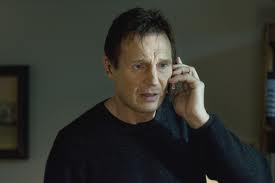
Section 2: Research into examples of comparable media products- Taken Screening Notes

 |
| Liam Neeson |
 |
| Her birthday party |
 |
| His daughter |
Section 2: Research into examples of comparable media products- The Phone Booth Screening Notes

Phone Booth
The first seconds of this thriller show the credits in a simple white square font. I think the text is straight and square like a phone box is and almost as if the wires from a phone have made up the lettering. The camera is zooming in through clouds and reaches a shot of stars in the sky where the camera then follows a satellite. This relates to the signals and phones used in the next part of the film. The music playing wile this visual is on the screen is a jolly soulful tune, that sings about ‘operators’ this relates to the subject of the film. It then shows the world from an outer space prospective and zooms in again narrowing the show down to countries, areas and eventually down to one man standing on his phone in New York City.
It shows a Chinese middle aged man on his phone which I think is a typical reference to the film’s title ‘Phone Booth’ it then shows a busy city from high angles again zooming in to smaller areas. I think the way the mese on scene has been used is showing how big the signals are and how many phones are used in the world which is also shown through many other ways in the opening sequence. The music is still in the background, with city noises over the top such as taxi’s and people talking. The camera then zooms in to show a group of young males who is creating the music on the street. I think this shows city life and introduces the setting well. This is continued when various shots are shows of money exchanging, street dance and culture in the city. In all of these shots there are various people on their phones in the fore ground and background, I think this anchors into the viewer what the whole film is based upon.
A deep man’s voice then overrides these shots introducing facts about how many people are in the city, how many have phones, how often they are used ect. I think this is a dramatic technique used to shock the reader in the high numbers of these things that would expectably be lower. The shots of all ages, genders and types of people continue to show life in the city and eventually get faster and closer together. Small squares then begin appearing on the screen of people on their phones, they build and build until they fill the screen when the conversation become louder and more muffled, this again emphasises the vast amount of people using mobile phones and pay phones.
 |
| Stu Shepard |
The phone booth is then introduced where further facts are told about it, this sets the viewer up for where they think the events to happen and tell them about it before this happens. Immediately after the main character of Stu Shepard is introduced, I think this is to show that they will meet during the film and this is where the main action will begin. He is wearing a smart suit, with a contrasting colour shirt. I think this shows his confident personality. He is also wearing sun glasses and has a neatly shaven beard. I think by looking at his appearance you can tell he is a business man as is shown because the first time we see him he is on his mobile phone. He seems arrogant and rude and ready for business as in a short space of time he speaks to around 6 of his clients on the phone and calls most of the ‘his favourites’. His assistant is a lot younger and seems to be learning along the way with him, he is also smartly dressed in a dark suit and is ordered around by Stu. The camera follows them in a fast paced way, as if it is trying to keep up with their busy lifestyle where eventually the separate and Stu goes into the Phone Booth and makes his first call. This then sets up the viewer by introducing the setting and main character in the first couple of minutes.
 |
| Stu and his assistant |
 |
The main character in the phone booth |
Wednesday, 29 December 2010


Section 3: Brainstorm of content and classification of film
Film Classifications

A ‘U’ certified film is suitable for audiences aged four years and over. ‘U’ films should be set within a positive moral framework and should offer reassuring counterbalances to any violence, threat or horror. I don’t think this will be suitable for a thriller, because it is for an older audience because it may contain violence, swearing and dark storylines.

A PG certified film is for general viewing, but may have scenes unsuitable for young children. Unaccompanied children of any age may watch. A ‘PG’ film should not disturb a child aged around eight or older. However, parents are advised to consider whether the content may upset younger or more sensitive children. I again don’t think this would be suitable because of the reasons above.

Exactly the same criteria are used to classify works at ‘12A’ and ‘12’. These categories are awarded where the material is suitable, in general, only for those aged 12 and over. Works classified at these categories may upset children under 12 or contain material which many parents will find unsuitable for them. I think a 12 is suitable for some thrillers, but not for ours because it will have some violent murder scenes I think 12 years olds may be offended by.

No-one younger than 15 years old may see a ‘15’ film in a cinema. A 15 certified film can have moderate sex and violence scenes, I think this would be the most suitable for out thriller, because 15 being the youngest age is suitable and will attract a more adult audience. This is the certification we have chosen to use.

No-one younger than 18 may see an ‘18’ film in a cinema and No-one younger than 18 may rent or buy an ‘18’ rated video work. I think this certification is too high for out thriller because we want it to have a wide audience so all can be entertained and enjoy it.


Subscribe to:
Posts (Atom)